Tag: budget

  • Top 10 reasons why visitors aren’t coming back to your business…

    Top 10 reasons why visitors aren’t coming back to your business…

    If you are like most small businesses then you spend a large amount of your marketing budget on acquiring new customers. And…

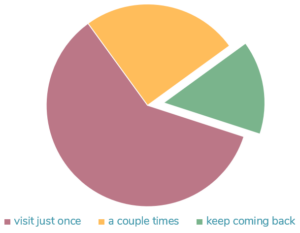
    Between 60-80% of those customers do not return after their first visit!

    This is bad news on many fronts…

    Whats worse is, most small businesses have resigned to this statistic.

    Its all about your mindset. Things can be very different if small business owners are to adopt a mindset similar to the larger and more advanced technology driven organizations of the world. Thankfully, you’ve got friends at connectchief who have the means to help you with that

    Take a look at these top 10 reasons and see if some of them are also reasons why your customers are likely not coming back. If you can find out what your customers are thinking & feeling the most and if you can do something about fixing it then you can be on your way to phenomenal growth. And thats what we’re here to help you do!

    While customer behaviors can vary, there are several common reasons why customers may choose not to return to a retail business.

    1. Poor Customer Service: Customers value excellent service. If they encounter rude or unhelpful staff, long wait times, or a lack of assistance, they may not want to come back.
    2. High Prices: If customers perceive that a retail business charges unreasonably high prices compared to competitors or the perceived value of the products or services, they may seek alternatives.
    3. Lack of Product Quality: Customers expect products that are reliable, durable, and of good quality. If they consistently experience issues with the quality or performance of products, they may look for better options elsewhere.
    4. Inadequate Product Selection: Customers appreciate having a wide range of products to choose from. If a retail business has limited selection or frequently runs out of stock, customers may be inclined to explore other stores with more options.
    5. Negative Online Reviews: With the prevalence of online review platforms, customers often research businesses before deciding where to shop. If a retail business has numerous negative reviews regarding service, product quality, or overall experience, it can deter potential customers from returning.
    6. Inconvenient Location: The location of a retail business can significantly impact customer retention. If it’s difficult to access, has limited parking, or is far from customers’ regular routes, they may opt for more convenient alternatives.
    7. Lack of Cleanliness and Maintenance: A clean and well-maintained store environment contributes to a positive customer experience. If a retail business is consistently dirty, disorganized, or in a state of disrepair, customers may perceive it as unprofessional and seek cleaner options.
    8. Ineffective Communication: Customers appreciate clear and timely communication from businesses. If a retail business fails to provide updates on product availability, changes in store hours, or upcoming promotions, customers may feel disconnected and choose to shop elsewhere.
    9. Unresolved Customer Complaints: How a retail business handles customer complaints is crucial. If a customer has a negative experience and the business fails to address their concerns or provide satisfactory solutions, it can lead to a loss of trust and loyalty.
    10. Lack of Personalization: Customers appreciate personalized experiences and recommendations. If a retail business fails to understand their preferences, provide tailored offers, or remember their previous interactions, customers may feel undervalued and opt for businesses that offer more personalized attention.

    While addressing each of these factors can be challenging, businesses that prioritize customer satisfaction, invest in staff training, maintain product quality, and foster strong communication channels are more likely to retain customers and foster long-term loyalty.

    At connectchief, we make software tools to help you power up your business.

    We can help your business with addressing and getting ahead of many of the above issues –

    1. connectchief can help you measure user experience in real-time and figure out the corrective actions you need to take to align with customer expectations. Ask us about visitXP and our retail analytics tools
    2. connectchief can help you find new customers – Ask us about promoENGINE
    3. connectchief can help you with tools that keeps you on top of mind with your new visitors and help you to bring them back. Ask us about loyaltyENGINE
    4. connectchief can help you build a communication bridge with your customers without spamming them on email – ask us about how we help you send out Announcements and flash sales
    5. connectchief can help you collect reviews from customers and showcase them at your place of business. Ask us about trustENGINE
    6. connectchief can also help you receive customer complaints and communications directly so you can respond to them promptly. ask us about hearecho
    7. we’re always interacting with our clients and helping them solve problems, improve efficiency and simply do better through use of technology. If you have ideas or suggestions, we would love to hear from you
  • How much does a typical small business in the US spend on online ads?

    The amount that small businesses spend on Google or Facebook or other online Ads varies widely, and there’s no set “average.” The amount a small business spends on Online Ads depends on several factors, including:

    1. Industry and competition: Some industries are more competitive than others, and therefore require more investment to drive results.
    2. Budget: The budget available for advertising will directly impact the amount spent on Online Ads.
    3. Target audience: Reaching a specific target audience will impact the cost, as more specific targeting often requires a higher budget.

    A small business can spend anywhere from a few hundred dollars to several thousand dollars per month on Online Ads, but most small businesses typically spend between $500 and $1,000 per month. It’s important to note that the best budget for a small business will depend on their individual goals and advertising needs.

    In addition, Businesses can spend anywhere from a few thousand dollars to tens of thousands of dollars per year on third-party social media management and online review management, with most small to medium-sized businesses spending between $2,000 and $10,000 per year.

    As opposed to the above, a small business can utilize the tools from connectchief to reach their target audience at almost half the cost of their typical online ads budget. Get started with connectchief for free while the software is in beta phase.

  • Introducing APIs to create custom promotions in promoEngine

    Our mission is to help our clients grow their business. In interacting with various clients we have come to understand that most businesses do not spend enough energy in building a coupon or promo code strategy simply becuase its very hard to actually implement.

    We see a lot of traditional stores, particularly grocery stores and some big box stores spending a lot of their marketing budget in putting out weekly / periodic sales flyers that include a large number of items that are on sale. It is common sense to assume that this is quite an effective way to market your products because we’re seeing large businesses do this for decades now and the activity has not stopped. If this form of marketing didn’t work, then clearly the big box and national chain stores would have stopped doing this a very long time ago.

    Large e-tailers do the same thing by issuing 1000’s of sales & discount coupons on products and services from time to time. In fact, deal-finding sites make millions of dollars in commissions every year by simply helping consumers find the right coupon that they can apply to their shopping cart? So clearly coupons & promotions work

    Why does this work?
    1. Weekly ad flyers and coupons enable a business to stay at the top of mind of its customers. Brand retention and recall is half the battle in any competitive market.
    2. Coupons or special pricing can create that extra motivation a consumer needs to ‘tap buy’. It helps you capture customers whose need exists but may not be urgent yet.
    3. Impulse buyers can be motivated through coupons or ads
    4. Frugal buyers plan ahead, they closely manage their expenses and are most likely to buying products when they go on sale. They are also likely to shop at stores that they perceive to have ‘wallet-friendly pricing’
    5. Online shoppers can shop from a lot of businesses sitting at home, so ‘better prices’ play a greater role in their purchase decisions. The success of platforms like slickdeals, honey and various others are a testament to the fact that coupons & promotions work as well in the online world as in the brick & mortar business space.

    Despite all this traction, we do not see too many small businesses (brick & mortar or online businesses or even ecommerce businesses successfully executing a STRONG COUPON & PROMOTIONS strategy)

    How is connectchief helping businesses build a better coupon & promotions strategy?

    We strongly believe that discounts is not a good strategy for every business. If by giving a discount, the perceived value (worth) of your offering gets diminished in your customers mind, then steer clear of discounts & coupons. But if you are not in that category of business, then we’ve created promoEngine for you. Using the connectchief scan & connect code, you can present your customers with a promotion or discount right at the time when they are at your store. You can also distribute your promotions digitally via the connectchief platform so customers can see your promotions when they are patronizing a business that collaborates with you. As an example: A customer can a coupon to visit your ice-cream parlor right when they are done paying the bill at a pizza place. Ofcourse, you will be returning the favor back to the pizza place by sharing their coupons with customers who might visit you.

    We’ve created many simple coupon & promotions templates that enable our customers (business owners like you) to create coupons that can be published by them on the connectchief promoEngine platform.

    So what is the custom promotions API

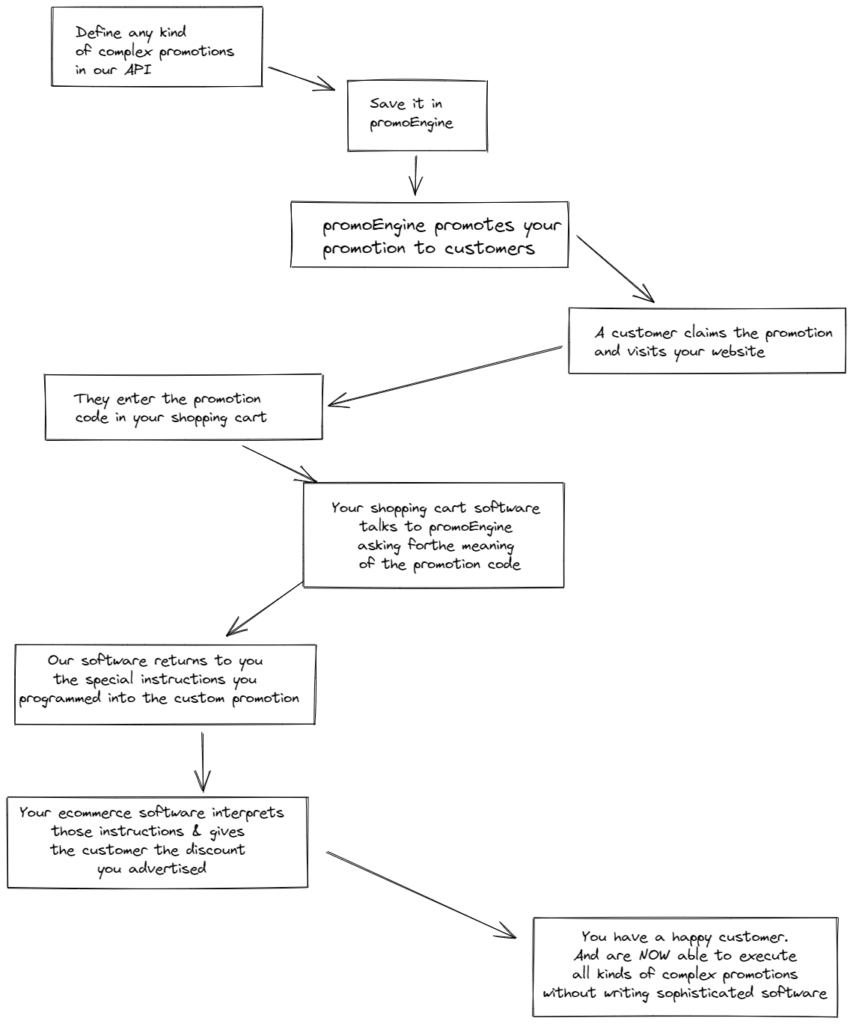
    Sometimes, you need to be able to create custom promotions because the basic promotions do not quite fit in with your business scenario. You can now do that through our promoEngine API (application programming interface) and some simple programming activity on your side.

    As an example – An ecommerce website could design a promotion in promoEngine for its customers to buy a 1-year subscription to their service and receive 1 extra month if they purchased the subscription before January 10, 2023.

    They would simply define a promotion in promoEngine using our API and specify the customer facing parts as in a catchy Title for their promotion, Add a banner image, Add a description describing the promotion & its terms in plain text. In addition, they can now setup a small set of rules in their preferred format that they can save alongside the promotion for it to be provided back to their ecommerce software when that promotion is being redeemed by a customer on their website. See the graphic below as a simple explanation.

  • Are ads a good idea for my business?

    Advertising is a good way to attract new customers and as a by-product also remind existing customers of your presence. However the goal of advertising is to inform the cusotmer of your message.
    The message in ads can be of one of 4 types. See more here

    Ads can be a good idea for your business if you have the following goals

    + You goal is to build brand recall

    Digital display ads are a great tool when your focus is to re-engage with non-returning customers or to build brand recall

    + When ad spend meets a ROI watermark

    We recommend you always have a clear ROI budget before you spend on ads. To achieve the right outcome, its equally important to be able to measure your targeted returns. As an example, if you say we want to get $1 back in revenue for every $1 spent on ads, thats an easy to achieve goal. However, are you measuring and more importantly are you able to reliably measure how much revenue you are generating from those specific ads.
    At connectchief, we often find ourselves saying “If you don’t know where you’re going, any road will get you there” This statement is as true for marketing spend on ads than anything else.

    + You wish to target users at a specific location or in a specific moment

    Running an ad for your ice-cream parlor at or near the campus of a local community college or elementary school is a great way to be in front of your customers when they are most likely to think (students wanting to hang out or families with kids looking for a treat) of a business like yours.

    Advertising a promotion is an even better way to run Ads

    + Promotions can be targeted to different user groups (aka cohorts)

    Promotions give the business a lot of flexibility. You could provide incentives to users for shopping at your store or to buy a certain product or service at an advertised price or to receive a discount for making purchases on a specific day or time. The opportunities are endless and when paired with location targeting can produce phenomenal results

    + Promotions are also a great way to acquire new customers

    Money spent on ads is cash spend. When money is given away through promotions, the spend is in goods or services – each of which have a higher perceived value to the consumer as opposed to the amount they cost you (the business owner to produce). Moreso, a promotion provides the consumer a way to try your product and services at a lower price point. You only spend, if they transact with you.

    + You are looking to engage with customers

    Promotions are generally structured as some benefit that a customer gets in exchange for a certain action. So a call-to-action is always built-into the promotion but it may not be the case for an advertisement. The ad is simply a means of informing the target user of your message.

    Advertising is meant to inform.

    Promotions are meant to engage. Promotions can be advertised too!

    What budget spend should one allocate on marketing activities ?

    This is an age old question. The answer is, it depends. As a thumb rule, if it costs you $x to acquire a custome through ads, are you able to generate 2x or better margin (not revenue) from that engagement? If yes, then the ad was worth it.

    Both ads and promotions are marketing tools. While advertising presents a reason to buy a product, sales promotion offers a short-term incentive to purchase

    The ultimate goal is to
    (1) Either acquire a new customer or
    (2) turn a one-time customer into a returning customer.
    Achieve any of the above and you are it mostly right.

    Any technology platform that offers ads allows you a lot of flexibility to experiment. Digital Ads are generally far more cost-effective over traditional media. They provide you to tune and customize your target audience. And most platforms are flexible where you can start, stop or even adjust your ad budgets at any time. The most important piece for any business (which most seem to forget is to measure if the ad or promotion is actually effective).

    PromoENGINE by connectchief takes a unique approach to promotions and ads. Our tools enable the small business to promote themselves to customers not just at vantage locations but also directly within your storefront (online or offline). Learn more about PromoENGINE and how these tools help you engage better with your target customers.

    How does a business turn a customer into a returning customer?

    Customers only return to businesses they like transacting with. They may find your product or services to be superior to other options. They may return because you are easy to do business with. They may return because your staff is caring and listens to its customers.

    To know if you are doing the right thing, you as a business owner or manager need to be in touch with your customers’ perception of the experience you and your team deliver. In business transactions, particularly service-oriented ones, customer experience issues can occur. However, a business that listens and attempts to make improvements, even if they delivered a poor experience to start, has a way higher chance of the customer returning to them vs one that seem to not care. Coming soon! with VisitXP business owners can get a quick check of their service delivery experience